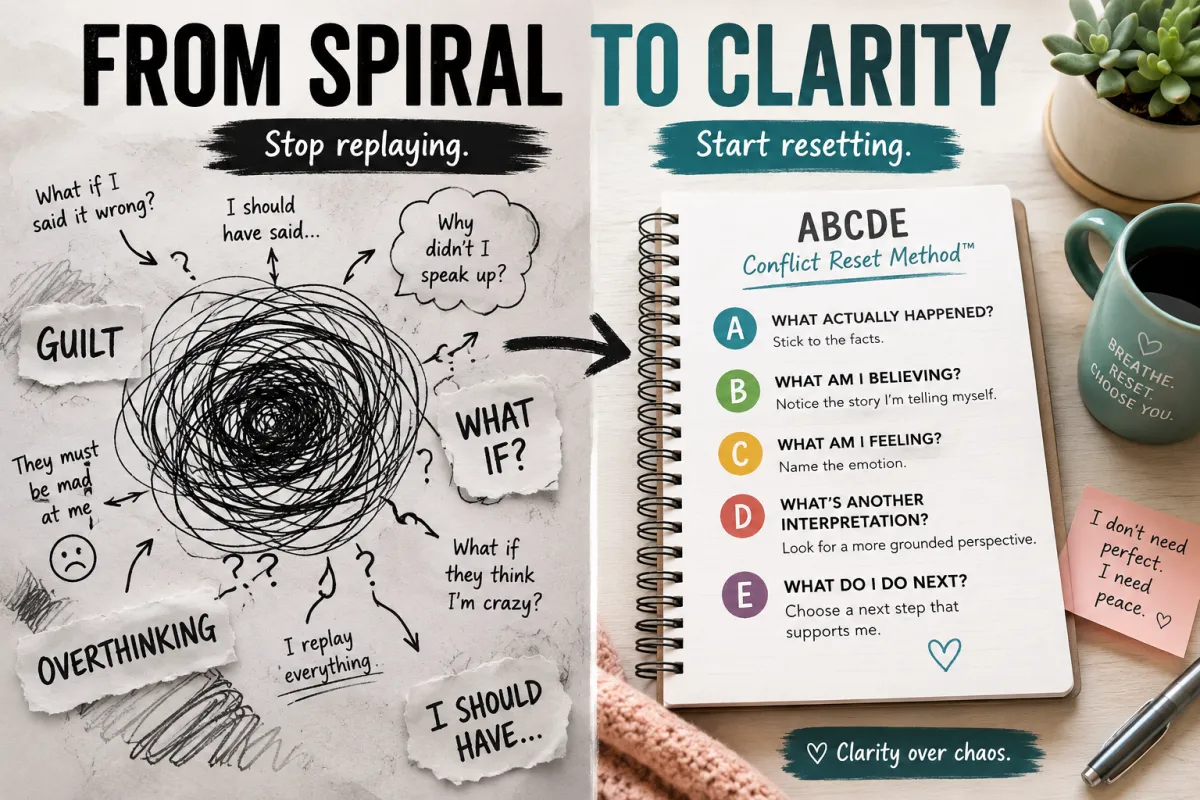
The ABCDE Conflict Reset Method™: What to Do When You Can't Stop Replaying a Conversation
The ABCDE Conflict Reset Method™: What to Do When You Can't Stop Replaying a Conversation
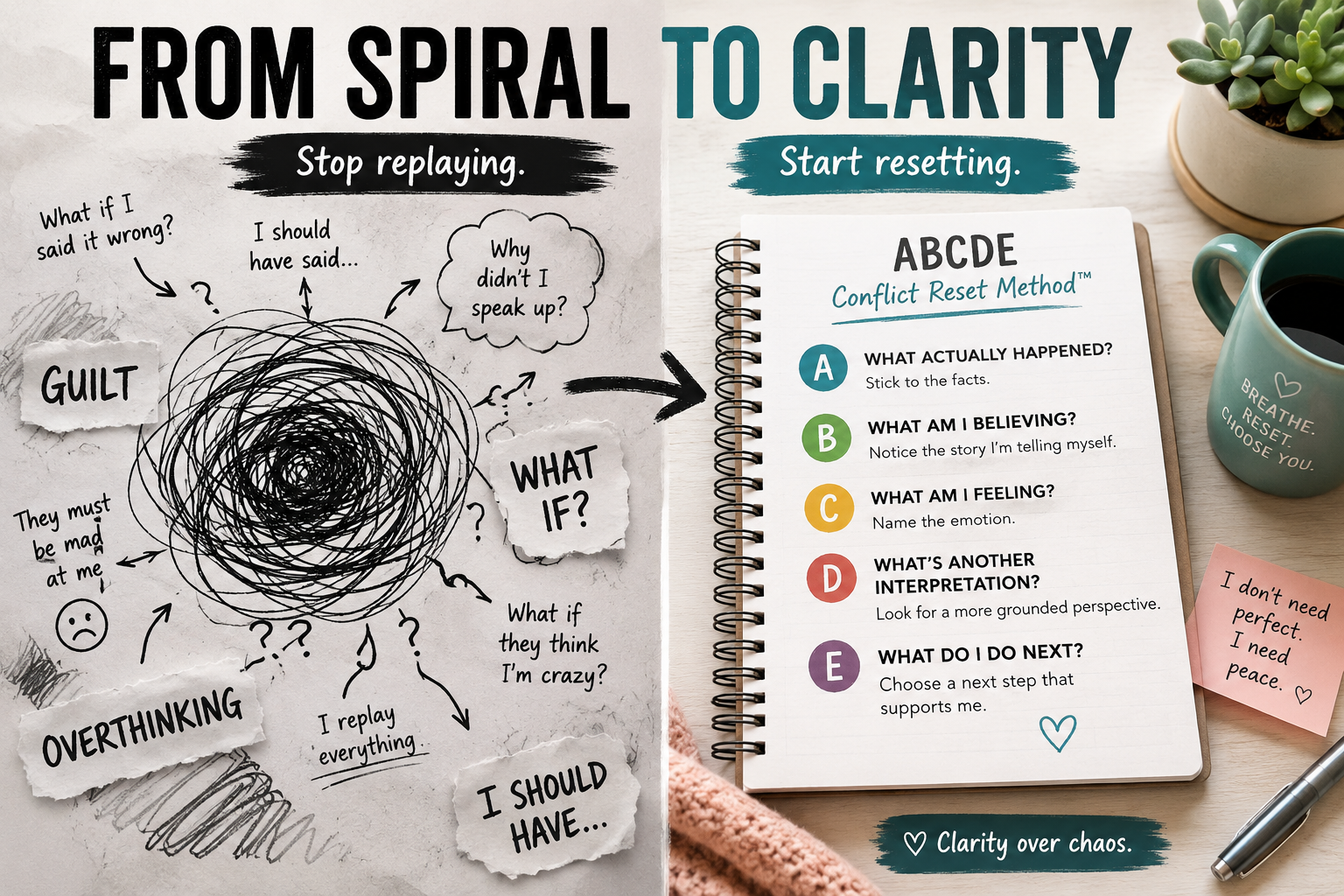
Have you ever had a conversation that ended hours ago... but somehow you're still having it in your head?
You replay what they said.
You replay what you said.
You think of seventeen better responses.
You wonder if you were too sensitive.
Then you wonder if you weren't sensitive enough.
And before you know it, you're mentally investigating the situation like you're preparing evidence for a trial no one asked for.
If you live with chronic illness, conflict often hits differently.
When your energy is already limited, a difficult conversation can feel less like a disagreement and more like an emotional system crash.
That's why one of the tools I teach inside the S.A.S.S. Method™ is the ABCDE Conflict Reset Method™.
Not because every conflict has an easy answer.
But because spiraling rarely gives us one.
Why Conflict Feels So Much Bigger When You Have a Chronic Illness
Many women I work with assume they're "too emotional" or "too sensitive."
They're not.
They're overloaded.
When you're managing symptoms, appointments, uncertainty, fatigue, pain, family responsibilities, and the pressure to keep functioning anyway, your nervous system is already carrying a heavy load.
A conflict doesn't arrive in an empty room.
It lands on top of everything else.
That's why a single comment can leave you replaying the conversation for days.
Not because you're weak.
Because your system is trying to make sense of something that feels emotionally expensive.
The problem is that endless analysis rarely creates clarity.
It usually creates more confusion.
That's where ABCDE comes in.
What Is the ABCDE Conflict Reset Method™?
The ABCDE Conflict Reset Method™ is a simple framework for processing conflict without getting trapped in guilt loops, shame spirals, or overthinking.
Instead of asking:
"What is wrong with me?"
You ask:
"What actually happened?"
Small difference.
Massive impact.
Here's how it works.
A = What Actually Happened?
Start with facts.
Not assumptions.
Not interpretations.
Not fears.
Just facts.
Ask yourself:
What was said?
What happened?
What did I observe?
For example:
Fact:
"My partner said they felt unsupported."
Not:
"My partner thinks I'm selfish."
One is information.
The other is a story your brain created at 2:17 a.m.
B = What Am I Believing About It?
This is where most spirals begin.
A conflict happens.
Then our brain fills in the blanks.
Ask yourself:
What meaning am I assigning to this?
What am I making this mean about me?
Examples:
I'm a burden.
I'm failing.
They must be angry with me.
I can never get this right.
I ruin everything.
Notice that none of those are facts.
They're interpretations.
And interpretations can be questioned.
C = What Am I Feeling?
Many women skip this step entirely.
Instead, they jump straight from thinking to fixing.
But emotions don't disappear just because we ignore them.
Ask yourself:
What am I actually feeling?
Examples:
Hurt
Embarrassed
Rejected
Guilty
Scared
Frustrated
Lonely
Try to be specific.
"Bad" is not an emotion.
It's a weather report.
We need a forecast.
D = What Is a More Grounded Interpretation?
This is not toxic positivity.
We're not pretending everything is fine.
We're looking for a perspective that is accurate and balanced.
Ask yourself:
What else could be true?
What would I tell a friend in this situation?
Is there another explanation?
For example:
Original belief:
"They're upset because I'm impossible to deal with."
Grounded interpretation:
"They're frustrated about a specific situation, not rejecting me as a person."
Original belief:
"I handled that conversation terribly."
Grounded interpretation:
"I was overwhelmed and didn't communicate as clearly as I wanted to."
One creates shame.
The other creates information.
Information helps.
Shame rarely does.
E = What Do I Do Next?
This is where you stop analyzing and start moving.
Ask yourself:
Do I need to apologize?
Clarify?
Rest?
Set a boundary?
Let it go?
Examples:
Send a follow-up message.
Schedule a conversation for later.
Write down what you want to say.
Take a break and revisit the issue tomorrow.
Decide that no action is needed.
Sometimes the next step is action.
Sometimes the next step is rest.
People with chronic illness often forget that rest is a valid strategy.
Your nervous system would like that memo distributed immediately.
A Real-Life Example
Let's say your friend says:
"You've canceled on me a lot lately."
A
My friend said I've canceled several plans.
B
They think I'm unreliable.
They're tired of me.
I'm a bad friend.
C
Guilt.
Sadness.
Fear.
D
My friend may be disappointed, but that doesn't mean they don't care about me.
Both things can be true.
E
Respond with honesty.
"I know I've canceled more than usual. My symptoms have been difficult lately, and I understand that it's frustrating. I value our friendship and want to find a way to stay connected."
Notice what didn't happen.
No shame spiral.
No self-destruction.
No writing your own emotional obituary because someone expressed disappointment.
Progress.
Why This Works
The ABCDE Conflict Reset Method™ helps create space between what happened and what you're telling yourself happened.
That space matters.
Because most conflict isn't actually resolved by thinking harder.
It's resolved by seeing more clearly.
When you can separate facts from fears, emotions from assumptions, and shame from reality, you gain access to something powerful:
Choice.
And choice is difficult to access when you're stuck in a spiral.
Final Thought
If you find yourself replaying conversations, over-explaining, shutting down, or carrying guilt long after a conflict ends, you're not broken.
You're likely operating without a structure that helps you process what happened.
The ABCDE Conflict Reset Method™ gives you that structure.
No drama.
Just data.
One step at a time.
One conversation at a time.
One less spiral at a time.
Ready for the Next Step?
Download the Stay Quiet or Speak Up?™ Decision Tool to learn how to make clearer communication choices in the moment, before conflict turns into hours of overthinking.